For First Time, Chimps Seen Making Weapons for Hunting


SOURCE: The Washington Post

AUTHOR: Rick Weiss, Washington Post Staff Writer

COMMENTARY: Allen MacNeill

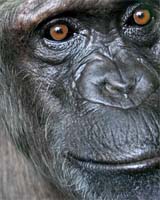
Friday, February 23, 2007: Chimpanzees living in the West African savannah have been observed fashioning deadly spears from sticks and using the tools to hunt small mammals — the first routine production of deadly weapons ever observed in animals other than humans. The multistep spearmaking practice, documented by researchers in Senegal who spent years gaining the chimpanzees' trust, adds credence to the idea that human forebears fashioned similar tools millions of years ago. The landmark observation also supports the long-debated proposition that females — the main makers and users of spears among the Senegalese chimps — tend to be the innovators and creative problem solvers in primate culture.

Using their hands and teeth, the chimpanzees were repeatedly seen tearing the side branches off long, straight sticks, peeling back the bark and sharpening one end. Then, grasping the weapons in a "power grip," they jabbed them into tree-branch hollows where bushbabies — small, monkeylike mammals — sleep during the day. In one case, after repeated stabs, a chimpanzee removed the injured or dead animal and ate it, the researchers reported in yesterday's online issue of the journal Current Biology.

"It was really alarming how forceful it was," said lead researcher Jill D. Pruetz of Iowa State University, adding that it reminded her of the murderous shower scene in the Alfred Hitchcock movie "Psycho." "It was kind of scary."

The new observations are "stunning," said Craig Stanford, a primatologist and professor of anthropology at the University of Southern California. "Really fashioning a weapon to get food — I'd say that's a first for any nonhuman animal."

Scientists have documented tool use among chimpanzees for decades, but the tools have been simple and used to extract food rather than to kill it. Some chimpanzees slide thin sticks or leaf blades into termite mounds, for example, to fish for the crawling morsels. Others crumple leaves and use them as sponges to sop drinking water from tree hollows.

But while a few chimpanzees have been observed throwing rocks — perhaps with the goal of knocking prey unconscious, but perhaps simply as an expression of excitement — and a few others have been known to swing simple clubs, only people have been known to craft tools expressly to hunt prey.

Pruetz and Paco Bertolani of the University of Cambridge made the observations near Kedougou in southeastern Senegal. Unlike other chimpanzee sites currently under study, which are forested, this site is mostly open savannah. That environment is very much like the one in which early humans evolved and is different enough from other sites to expect differences in chimpanzee behaviors.

Pruetz recalled the first time she saw a member of the 35-member troop trimming leaves and side branches off a branch it had broken off a tree.

"I just knew right away that she was making a tool," Pruetz said, adding that she suspected — with some horror — what it was for. But in that instance she was unable to follow the chimpanzee to see what she did with it. Eventually the researchers documented 22 instances of spearmaking and use, two-thirds of them involving females.

In a typical sequence, the animal first discovered a deep tree hollow suitable for bush babies, which are nocturnal and weigh about half a pound. Then the chimp would break off a branch — on average about two feet long, but up to twice that length — trim it, sharpen it with its teeth, and poke it repeatedly into the hollow at a rate of about one or two jabs per second. After every few jabs, the chimpanzee would sniff or lick the branch's tip, as though testing to see if it had caught anything.

In only one of the 22 observations did a chimp get a bush baby. But that is reasonably efficient, Pruetz said, compared with standard chimpanzee hunting, which involves chasing a monkey or other prey, grabbing it by the tail and slamming its head against the ground.

In the successful bush-baby case, the chimpanzee, after using its sharpened stick, jumped on the hollow branch in the tree until it broke, exposing the limp bush baby, which the chimp then extracted. Whether the animal was dead or alive at that point was unclear, but it did not move or make any sound.

Chimpanzees are believed to offer a window on early human behavior, and many researchers have hoped that the animals — humans' closest genetic cousins — might reveal something about the earliest use of wooden tools. Many suspect that the use of wooden tools far predates the use of stone tools — remnants of which have been found dating from 2.5 million years ago. But because wood does not preserve well, the most ancient wooden spears ever found are only about 400,000 years old, leaving open the question of when such tools first came into use. The discovery that some chimps today make wooden weapons supports the idea that early humans did too — perhaps as much as 5 million years ago — Stanford said.

Adrienne Zihlman, an anthropologist at the University of California at Santa Cruz, said the work supports other evidence that female chimps are more likely than males to use tools, are more proficient at it and are crucial to passing that cultural knowledge to others.

"Females are the teachers," Zihlman said, noting that juvenile chimps in Senegal were repeatedly seen watching their mothers make and hunt with spears.

Females "are efficient and innovative, they are problem solvers, they are curious," Zihlman said. And that makes sense, she added.

"They are pregnant or lactating or carrying a kid for most of their life," she said. "And they're supposed to be running around in the trees chasing prey?"

Frans B.M. de Waal, a primatologist at Emory University, said aggressive tool use is only the latest "uniquely human" behavior to be found to be less than unique.

"Such claims are getting old," he said. "With the present pace of discovery, they last a few decades at most."

COMMENTARY:

Yet another supposedly significant difference between humans and non-human animals falls by the wayside. It would be really interesting to know when this behavior first began, and where (and by whom). Based on what we already know about chimp learning behavior, it is very likely that a young female first tried this technique, possibly modeling it on the already well-developed technique of using a twig stripped of its branches to "fish" for termites in termite mounds. Also, it is likely that the technique has spread via imitation, rather than by directed learning. Chimps (like many other primates) are very good at imitative learning, but apparently do not actually "teach" each other how to do things...but maybe this will also be observed at some point in the future.

Furthermore, it is clear that the female chimps fashioning these spears are doing so intentionally: they perform a specific, learned behavior with the intent to use it to extract food (i.e. bushbabies) from locations that would otherwise be inaccessible. A clear case of "design" in a non-human animal, and clearly learned/based on experience (i.e. not innate/hard-wired). Anyone who argues that "design" or "intentionality" does not exist in nature is either deliberately self-deceived or stupid.

Does this mean that "design" is an intrinsic property of nature, however? Not at all; rather, it shows that "design" (i.e. intentional behavior) can be an emergent property of a particular class of natural entities. We know that we are capable of intentional behavior, and now we have solid evidence that chimps are as well. However, none of this is evidence for the kind of "intrinsic design" that "intelligent design theorists" propose as an explanation for the origin of complex adaptations. Rather, it is evidence for the kind of "emergent design" that Ernst Mayr explained as fully compatible with evolutionary theory more than thirty years ago.

--Allen

More on Steve Fuller and "Social Epistemology"

SOURCE: Cornell IDEA Club

AUTHOR: Allen MacNeill

The debate begun in my previous post continues...

A poster to the Cornell IDEA Club listserve wrote:

"Fuller '... deserves to have his ideas discussed instead of lambasted.'"

Okay, here's something to discuss (a direct quote from Fuller):

"In this respect, 'our' side pulled its punches in the Science Wars when it refused to come out and say that the scientific establishment may not be the final word on what science is, let alone what it ought to be." [emphasis mine]

In that one sentence alone is encapsulated nearly everything that most practicing scientists find so deeply objectionable about Steve Fuller and his ilk. Let's take it apart:

"'our' side"

What precisely does Fuller mean by this? "Our side" in what way? "Our side" in the evolution/ID debate? The natural science/social science debate? The science/sociology debate? The "culture wars" that Phillip Johnson says ID is part of? What does it mean to say you're on a "side"?

When I debate with other scientists about scientific subjects, those debates can be pretty heated, but generally we're all on the same "side": the "side" of empirical verification/falsification of explanations of natural phenomena. In other words, we're all on the "science side," the side that does what it does based on the premise that such explanations should be grounded in observation of nature and the investigation of natural causes for natural phenomena.

I don't think that's what Fuller means by "our side." Sociologists in general, and "social epistemologists" in particular have as a basic starting assumption that all explanations of all phenomena (natural or otherwise) are ultimately socially constructed.

Now, I have no problem with that idea per se, as I believe as well that such explanations are indeed socially constructed. What I and other scientists have a problem with is the seemingly inevitable logical extension of that idea which most sociologists (and I would put Fuller in this camp) seem prone to: that nature itself is therefore "socially constructed." That's what "social epistemology" means, isn't it? That what we know about reality (i.e. epistemology) is socially constructed, and that therefore we can't actually know anything about nature at all outside of our social construction of it.

But this is precisely what science was and is supposed to be about: the discovery and understanding of what nature is, independent of our opinions and "social constructions." That's why statistical analysis was developed, to remove as much as possible our subjective/socially constrained interpretation of what our observations mean vis-a-vis our explanations about how nature works. That's why we have "double-blind" experimental protocols, and why we argue so vehemently over the validity of data and what it means for theories: because, in the end, all scientists agree that this is the best we can do at understanding how nature works.

But Fuller and his cohorts do not agree; they think that real scientific objectivity (and hence the entire scientific enterprise) is impossible, and that since all scientific explanations are "socially constructed," it all comes down to "sides" and "debates" and, most of all, WINNING. It call comes down to politics, in other words.

"Science Wars"

Here it is in a nutshell. Wars between whom, precisely? Between scientists, who believe that they really are able to say something about the nature of nature, and non-scientists, who believe that it's all really about political power and "hegemony" and "patriarchy" and winning. What happens when you fight a "war", including a "culture war"? Somebody WINS.

"the scientific establishment"

More tired 1970s radical political rhetoric, all dressed up in "scienciness" (like "truthiness" only more "scientific") to impress the gullible and gratify the "politically correct". Yes, I'd be the first to admit that there are "science establishments" - I live and work in one of them. But that's not what Fuller is talking about here. He's talking about the capital E Establishment: the "bad guys" on the other "side", the scientists who believe that they are describing physical reality, when what they are really doing is "oppressing" the poor and downtrodden of the world, the victims of "patriarchy" and "political hegemony" and their advocates, the "social epistemologists", who tell them that there is no objective reality outside of social discourse, and debates are all about WINNING and not about refining our understanding about how nature works.

His mention of the Sokal affair is also telling in this respect. The Sokal affair decisively exposed the intellectual bankruptcy at the heart of sociology and "social epistemology" - the belief that everything is socially constructed. Not just our understanding of reality, but reality itself.

"the final word on what science is"

Hmm, well, what does this tell us about Fuller et al? Who should have the "final word" about anything? The people doing it, or the people criticizing it? Who is the real subject - the monster or the critics (as Tolkein so eloquently put it)? True, scientists sometimes don't completely understand why they do things the way they do (i.e. some of them follow instructions, like an apprentice emulates a master), but this does not mean that scientists don't really understand why we do what we do and need somebody like Fuller to tell us.

Why not? Because social "scientists" like Fuller (and like ID "theorists") don't do natural science. They "interpret" or "criticize" or "analyze" what natural scientists do, but they don't do what natural scientists do. If they did, Alan Sokal's trick would not have worked, but instead it sucked them all in, so deep that some of them still don't realize how completely their intellectual bankruptcy was exposed by the "Sokal affair."

"let alone what it ought to be"

And there it is, right there in plain English. The people who DO science are probably the last people who should have anything to say about how science ought to be practised, right? Because, of course, we're all "blinded by science" and don't understand that it isn't about objective analysis of nature, it's about "social construction of reality" which ultimately is about politics (from the Greek polis, for "people"), which is about WINNING.

So, yes, I find it fascinating that ID advocates, the vast majority of whom are deeply committed Christians, can find common cause with Fuller and other "social epistemologists." Christian belief, as I understand it, is ultimately based on unshakable faith in the truth of the Word: the logos of the gospel of John. But, to somebody like Fuller, the Word is just another form of "social discourse", just part of a political struggle of which the ultimate point is WINNING. Why does Phillip Johnson call what he's doing part of a "culture war?" Why does William Dembski and Robert Crowther and Stephen Meyer and Jonathan Witt and Benjamin Wiker (but, significantly, not Michael Behe nor Gullielmo Gonzales, both natural scientists) agree with Johnson? Because that's what they're doing, they're fighting a war, and as I said in my last post, wars aren't about truth, they're about WINNING. Truth be damned, so long as your side WINS. "Lying for Jesus" is justified, and no amount of distortion of experimental results or character assassination or egregiously twisted and vicious propaganda is too much, so long as your side WINS.

Isn't the quotation from Fuller that stands at the top of this post an indication that he sees what he and other "social epistemologists" do is ultimately all about winning? Seems like it to me...

--Allen

On the "Darwin Fetish" and Other Political Oxymorons


SOURCE: Cornell IDEA Club

AUTHOR: Allen MacNeill

The IDEA Club at Cornell has recently been discussing the following quote by Steve Fuller, a sociologist and one of the "experts" who testified in support of "intelligent design" at the Dover trial in Pennsylvania last year:

"If you want to stop use of the word 'Darwinist' to capture modern evolutionary theory, then you should encourage people like Dawkins, Jones, Wilson, Watson, Ridley and (were he alive) Gould to stop talking about 'Origin of Species' etc. as if they were books of some secular Bible. This kind of thing doesn't happen in physics. The world-view implications of physics can be discussed, while giving due respect to Newton, Einstein, etc., without trying to find bits of their texts that anticipate or legitimise what the author wants to say today . From a sociological standpoint, the Darwin fetish is very weird, and doesn't seem to be related to any claims that creationists or ID people are making. Marx and Freud are the only figures who have been treated this way in recent memory – and you've seen what's happened to them…"

Here's my take on all of this:

It sounds to me like Fuller is objecting to the idea that biologists, especially evolutionary biologists, cite Darwin as a published authority when writing (and talking and teaching) about their own work. However, this is exactly what you're supposed to do in science: back up your assertions with citations whenever your assertions are not completely original. Fuller, who is not a natural scientist but rather a sociologist, doesn't seem to understand this basic fact. Indeed, he seems to think that citation is somehow illegitimate in science, even that it may indicate some kind of slavish adherence to dogma, rather than simply an attempt to ground one's own work in previous work on the same subject.

If I were to cite W. D. Hamilton on the subject of kin selection, for example, does that mean that I have some kind of "Hamilton fetish?" What if everyone who works on kin selection does the same thing; does this mean that we're "deifying Hamilton?" No, the whole idea is absurd; citation is both an accepted and indeed required part of standard science writing, teaching, and speaking.

It goes deeper than this, of course. The reason that Fuller was chosen as one of the "experts" in defense of "intelligent design" at the trial in Dover, PA was because Fuller (like many sociologists today) is a "post-modernist." This means that, like post-modernism's founders such as Foucault and Derrida, Fuller believes and promotes the idea that "all knowledge is reducible to 'discourse'" in which politics is the ultimate force, and political victory over one's intellectual opponents is the ultimate goal. Fuller and others like him argue that there is no such thing as "objective knowledge" at all, only competing ideologies. According to this view, science is just another way for the "dominant white patriarchal class to extend its hegemony" by forcing others to believe in its politically motivated view of reality, and that all intellectual debates are really just part of the ongoing class struggle for political power.

It surprises me, therefore, that "intelligent design" supporters would cite Fuller and promote his ideas, which are of course ultimately based on Marxist (and therefore atheist) theories. Politics indeed makes for strange bedfellows, and to see Christian supporters of ID cite Fuller and others like him as authorities and supporters of their world view strikes me as laughable and ultimately self-defeating.

Yet at the same time, it doesn't surprise me, because that's what "intelligent design theory" started out as and has remained: not science, not the legitimate search for knowledge derived from empirical analysis of nature, but rather politics, pure and simple. This is why IDers don't publish in scientific journals, but rather push their agenda in the media, the courts, and in elections. ID isn't science, it's politics, conducted by press release and lawsuit, and its goal isn't the expansion of knowledge or understanding, it's winning by whatever means possible: distortion, misrepresentation, mischaracterization, even character assassination and outright lying are sanctioned, so long as they promote the ultimate goal: the victory of ID (and therefore the forces of "good," i.e. Christianity) over evolution (and therefore the forces of "evil," i.e. evangelical atheism).

How else to explain such masterpieces of political propaganda as Phillip Johnson's The Wedge of Truth or Benjamin Wiker's Moral Darwinism? The former was written by the acknowledged founder of "intelligent design theory," and the latter was published with a foreword by William Dembski in which he lavishly praises Wiker for getting down to the real issues in the evolution/intelligent design debate. IOW, it's not about knowledge, it's all about winning folks, and cultural warfare (Johnson's term) is just politics by other means. And in cultural warfare as in war in general, the first casualty is the truth...

--Allen

Kansas: Anti-Evolution Guidelines Repealed


ARTICLE: Kansas: Anti-Evolution Guidelines Repealed

SOURCE: Associated Press

COMMENTARY: Allen MacNeill

First, the news item, followed by a few brief comments:

ASSOCIATED PRESS (Published: February 14, 2007): The State Board of Education repealed science guidelines questioning evolution, putting into effect new ones that reflect mainstream scientific views. The move was a political defeat for advocates of “intelligent design” who had helped write the standards being repealed. The intelligent design concept holds that life is so complex that it must have been created by a higher power. The board removed language suggesting that basic evolutionary concepts were controversial and being challenged by new research. It also approved a new definition of science, limiting it to the search for natural explanations of what is observed in the universe. The state has had five sets of science standards in eight years, each affected by the seesawing fortunes of socially conservative Republicans and a coalition of Democrats and moderate Republicans.

COMMENTARY:
This was inevitable, given the outcome of last year's state board of education elections, but it's still nice to know that the newly elected board of education candidates followed through on their campaign promises. An interesting sidelight to this story comes from an email I received late last week. The email came from Rob Crowther of the Discovery Institute, home church of the "intelligent design movement" (yes, I'm on their mailing list; it's always good to know what the other side is doing). In the email, Crowther railed against the new Kansas science standards, but the interesting thing is that he railed specifically against the removal of an item about the abuse of science (the rise and fall of eugenics in the 20th century and the Tuskegee syphilis study were the main examples). The email encouraged me to send an email to the board of education protesting the new standards because they included this change. Interestingly, there was no mention at all in the email of the fact that almost all of the proposed changes are to the parts of the old standards dealing with evolution and "intelligent design." Hmm...it appears that deliberate prevarication is part and parcel of the Discovery Institute's modus operandi. Crowther is a master propagandist, and his work in this case would have made Goebbels proud...

--Allen

Island Mice May Evolve Faster: From One Species To Six In 500 Years


SOURCE: Genome News Network

AUTHOR: Bijal P. Trivedi

COMMENTARY: Allen MacNeill

An alert Evolution List reader has already pointed me to an article that first appeared on April 28, 2000, concerning the unusually rapid speciation of common European mice on the island of Madeira. Apparently, these mice were brought to the island on sailing ships, most likely from Portugal. Since such ships were very small, the total size of the founding populations would have been extremely small; probably less than a dozen individuals (and certainly less than a hundred).

This would certainly qualify as precisely the kind of founder population that I described in the previous post concerning a possible mechanism for chromosomal speciation. In particular, it is extremely interesting that the mice in question have apparently speciated in less than 500 years, and that the mechanism underlying this speciation has involved multiple chromosomal fusions.

Here’s the full article describing the research (commentary follows):

Janice Britton-Davidian spent several weeks in 1999 placing hundreds of mousetraps all over the semi-tropical island of Madeira and discovered what may be an example of "rapid evolution." She caught hundreds of small brown mice that look pretty much alike but that are genetically distinct—a very unusual thing for such a small, geographically contained place. It normally takes thousands to millions of years for one species of animal to diverge to become two. On Madeira, one species may have evolved into six in the space of just 500 years.

Britton-Davidian, an evolutionary biologist at Université Montpellier II in Montpellier, France, showed that populations of Maderian mice have between 22 and 30 chromosomes, even though their ancestors, who first arrived with the Portuguese in the 15th century, had 40.

Madeira is a rugged volcanic island with sharp black cliffs that block all but a few isolated rocky shores. Only a few small villages decorate the strip of coast. The Portuguese were first to inhabit the island, bringing with them the mice that Britton-Davidian so avidly seeks. As the Portuguese founded small settlements around the island, they inadvertently deposited small groups of mice at each stop. And, for the last five centuries, mountainous barriers have prevented these coastal colonies of rodents from commingling.

Britton-Davidian collected hundreds of mice from about 40 locations around the island and found six distinct populations. The common brown house mouse of Europe, presumably the ancestor of the Madeira mice, has 40 chromosomes, but the six families of Madeiran mice have between 22 and 30.

The current families of Madeiran mice are not short of genetic material. They have not lost any DNA. What happened is this: over time, some of the chromosomes fused together, packing more DNA into some chromosomes. Each of the six unique populations of mice on Madeira has its own special assembly of fused chromosomes. Each group of mice may now be its own species.

The diversity of fused chromosomes seems to have occurred in just 500 years, or between 1,500-2,000 generations of mice, says Britton-Davidian. Furthermore, the huge diversity in chromosomes has evolved solely from geographic isolation rather than adaptations to different environments.

"What is surprising is how fast this has taken place," says Scott Edwards, an evolutionary biologist from the University of Washington, in Seattle. Based on fossil records of sea urchins and invertebrates, evolution of different species is thought to take thousands to millions of years. "But this is an interesting case because it may prove to be an extreme case of rapid speciation," says Edwards.

Britton-Davidian wants to know whether these populations of mice have evolved into different species or whether they are on the cusp of speciation. A species is defined as a group of organisms that can mate and produce fertile offspring.

One of Britton-Davidian's most surprising findings is that she and her colleagues found no mice that are hybrids among any of the six groups. "This might be because the hybrids are infertile or they may be less fit than the parents and unable to survive," says Britton-Davidian. Other explanations could be that the groups have been geographically isolated and have not had the chance to mate, or that the mice "recognize each other as different and choose not to mate."

Britton-Davidian has taken some mice from Madeira back to her lab in France and will try interbreeding the six populations to confirm whether the hybrid mice are infertile, which, if they are, would imply that the different groups were in the process of speciation. Her team will also observe the mice to see whether they show behavioral or physical differences.

REFERENCES CITED:

Britton-Davidian, J. et al. Rapid chromosomal evolution in island mice. Nature 403, 158 (January 13, 2000).

COMMENTARY:

I must admit that I did not expect to find evidence supporting my hypothesis so quickly; thanks to list reader Zachriel for finding the article posted above. Several items in the article immediately struck me:

• The mice in question were “seeded” in six isolated communities, presumably unintentionally (i.e. in boxes, foodstuffs, or by climbing down mooring lines). These would qualify as six separate, very small founder populations.

• The mountains separating the six populations would effectively isolate the populations, preventing gene flow and maintaining the populations at very low sizes (i.e. the surrounding environments would not be conducive to allowing the mice populations to expand, as they are adapted to living in human habitations).

• The six populations differ almost entirely in chromosome number, but not in apparent phenotype, as predicted by my hypothesis.

I haven’t had time to follow up and check to see if Britton-Davidian has been able to correlate the chromosomal differences between the six different mice populations and their behavior, etc. As readers of the previous post might suspect, my hypothesis does not necessarily predict that there will be any such differences at all. On the contrary, chromolocal mutations (such as the multiple fusions found in the Madeiran mice) don’t change the genetic information, they simply rearrange where it is located in the genome.

If the foregoing does indeed support my hypothesis (and if the hypothesis eventually is shown to be valid) it says something very interesting about speciation and its relationship to natural selection (and, by extension, the “modern evolutionary synthesis”). According to the “modern synthesis,” speciation is the result of geographic isolation and diversifying selection (as originally proposed by Mayr and Dobzhansky), with selection playing an important role in reinforcing species differences via the intensification of “isolating mechanisms.”

However, my “first-degree inbreeding” hypothesis implies just the opposite: that the genetic processes that isolate populations (which subsequently become species) happen first (i.e. chromolocal mutations, etc.), thereby effectively isolating the populations entirely by accident, and that later the already isolated populations begin to diverge in character as the result of selection, drift, etc.

It also implies very strongly that macroevolution (defined as evolution at the species level and above) actually happens virtually instantaneously, as the result of genomic rearrangements such as chromolocal mutations, with phenotypic diversification taking much longer. This squares with the fundamental difference between cladogenesis (i.e. macroevolution) and anagenesis (i.e. microevolution), as the former is essentially instantaneous at the moment of divergence of a new clade, whereas the latter takes time...lots of time, as Darwin first pointed out.

In closing, it is interesting to contemplate the mounting evidence for surprisingly rapid cladogenesis in nature, as shown by the cichlids of Lake Victoria and the mice of Madeira. As I have said before, these newly emerging ideas are diffficult to reconcile with some of the main tenets of the "modern evolutionary synthesis" (although they fit well with Darwinian theory overall). Once again, "The modern synthesis is dead; long live the evolving synthesis!"

I would really appreciate comments, suggestions, and especially criticisms of the foregoing and of my proposed hypothesis. Just click on my name, below, and send me an email, or just click on the “Comments” link. I’ll get your message either way, and will respond as quickly as ever I am able.

--Allen

Hypothesis: First-Degree Inbreeding Facilitates Chromosomal Speciation


AUTHOR: Allen MacNeill

SOURCE: Original essay

COMMENTARY: That's up to you...

Happy Thanksgiving!

To help you enjoy the holiday, let me offer you a hypothesis that I have been working on to explain the origin of species in animals. The inspiration for this hypothesis was a debate at Uncommon Descent in which I have been embroiled for the past few days. The debate began with a discussion of the possibility of "virgin birth" in humans. The poster, DaveScot (not his real name) started out with a description of meiosis that contained an egregious error: that the first division of meiosis results in two diploid daughter cells. As every introductory biology student knows, this is incorrect: the first division of meiosis produces two haploid daughter cells in which the chromosomes are still double-stranded. The second division of meiosis is essentially a mitotic division, separating the sister chromatids in the double-stranded chromosomes of the first-division daughter cells.

The debate moved on, eventually centering on the subject of the chromosomal basis for speciation. I mentioned that speciation is the result of genetic isolation, and that in many cases (but not all) it is associated with chromosomal fission, fusion, inversion, and translocation events. For example, one of the main differences between humans and other great apes is that humans have one less pair of chromosomes; 46 instead of 48. Recent genomic research has shown that this difference is the result of the fusion of two of the chromosomes of great apes to form the human chromosome #2. This led to the following question from one of the participants in the debate:

"Wouldn't this fusion event have to occur within at least two members- one male, one female- of the same population in order for it to have any chance of getting passed on?"

To which I answered:

No. All that would need to happen to make this possible would be for two first-degree relatives carrying the translocation to mate and have offspring. First degree relatives (i.e. parents and offspring or full siblings) can easily have the same chromosomal mutation (i.e. a fusion/fission/translocation/inversion), as they would inherit it from a single parent. If they were to mate with each other (a not uncommon event among non-humans...and even among some humans), they would be able to produce fertile offspring carrying the same chromosomal mutation.

Yes, it is true that first degree mating carries with it the possibility of reinforcement of recessive lethal alleles. However, as many geneticists and evolutionary biologists have repeatedly pointed out, this is actually beneficial to the population within which such reinforcement happens, as the alleles are removed from the population as a result.

In other words, mating between first degree genetic relatives within a small, isolated population would have the effect of both removing deleterious alleles from the population and allowing chromosomal mutations to spread throughout the population, especially if such mutations were at all beneficial (although they would diffuse almost as well if they were selectively neutral, as would probably be the case given that no change in overall genetic information would have occurred).

Furthermore, the hypothesis that I have presented above squares very well with the currently prevailing theory of speciation: that of peripatric speciation, as first proposed by Ernst Mayr. According to Mayr's theory, speciation occurs most often in small, isolated populations on the periphery of large, panmictic populations. There is abundant natual history evidence that this is the case, especially in animals.

However, no one has yet explained how peripatric speciation would come to be associated with the kinds of chromosomal changes that we have been discussing. My hypothesis – that first-degree inbreeding facilitates chromosomal speciation – is an attempt to reconcile those two observations.

In a large, panmictic population, selection would tend to eliminate individuals who mate with first-degree relatives as a result of decreased viability due to inbreeding depression and the increased frequency of expression of homozygous lethal alleles.

However, in very small, isolated populations individuals who occasionally mate with first degree relatives (i.e. "facultative first degree inbreeders") could easily have a selective advantage of individuals who avoid mating with first degree relatives (i.e. "obligate outbreeders").

Males in particular would tend to loose less as the result of mating with first degree relatives, as their parental investment in offspring is lower (i.e. they can waste gametes and even zygotes by mating with their first degree relatives, without significantly decreasing their reproductive success).

However, even females can cut their losses by mating with first degree relatives if the likely alternative is failure to mate at all due to unavailability of non-relatives. This would especially be the case in small, isolated populations, which are exactly the kind of populations in which speciation is most likely to occur.

The effects described above would be facilitated by increased genomic homogeneity, such as would result from genetic bottlenecks and founder effects. This is because close inbreeding intensifies genomic homogeneity and decreases genetic variation, especially in isolated populations with decreased gene flow from other populations.

This hypothesis – that first degree inbreeding facilitates chromosomal speciation – immediately suggests a series of predictions, all of which are empirically testable:

• The frequency of mating between first degree relatives should be inversely correlated with effective breeding population size. That is, the smaller the effective breeding population, the greater the frequency of mating between first degree relatives (i.e. “first degree inbreeding”).

• The increased frequency of “first degree inbreeding” in such populations should be more pronounced in males. That is, males should be more likely to attempt mating with first degree relatives, especially in small, isolated populations.

• The frequency of “chromolocal mutations” (that is, chromosomal fission/fusion/inversion/translocation mutations) should also be inversely correlated with effective breeding population size. That is, the smaller the effective breeding population, the greater the frequency of viable “chromolocal mutations.”

• Peripatric speciation events should be correlated with small population size, chromolocal mutations, and first degree inbreeding.

• Speciation resulting from chromolocal mutations should be much less common in large, panmictic populations.

• First degree inbreeding should also be much less common in large, panmictic populations.

• The success rate of artificial (i.e. facilitated/forced) first degree mating should be directly correlated with the degree of inbreeding. That is, the more inbred a population, the more successful artificial first degree inbreeding should be.

• Paleogenomic analysis should find close correlations between genetic bottlenecks, founder events, and peripatric speciation events and the frequency of chromolocal mutations and genetic homogeneity (resulting from first degree inbreeding).

• Relatively large changes in phenotype resulting from chromolocal effects should be more common in small, isolated populations.

• Speciation should be easier (and therefore more frequent) among asexually reproducing eukaryotes, such as plants and parthenogenic animals (among whom aneuploidy is largely irrelevant).

Let me stress two things about the foregoing:

• What I am suggesting is, at this stage, merely a hypothesis, but one that generates a series of immediately testable predictions.

• The hypothesis is, of course, based on the idea that incest (i.e. first degree inbreeding) is the most likely explanation for the diffusion of chromolocal mutations throughout small, isolated populations of animals. Let me stress as strongly as possible that I am NOT advocating incest, I am simply pointing out that first degree inbreeding would facilitate the kind of chromolocal mutations that are often correlated with species differences in animals. The same is also true for plants, of course, but in plants we don't call it "incest," we call it "self-pollination."

I would like to also add at the end of this presentation that my reading of John Davison's papers in which he details his "semi-meiotic hypothesis" for the origin of species were an indirect inspiration for my own efforts. While his hypothesis would work, its most significant drawback is that it requires an almost unlimited number of independent "reinventions" of the same mechanism (i.e. semi-meiosis) for speciation that results from chromolocal effects to be the basis for speciation throughout the animal kingdom. Not impossible, but extremely unlikely.

By contrast, my "first degree inbreeding hypothesis" does not require independent "reinventions" of semi-meiosis at all. The only thing it requires is that first-degree inbreeding occur in small, isolated populations of animals, an easily testable prediction that does not require elaborate genetic mechanisms to produce the predicted outcome: that is, genetic isolation and subsequent speciation.

I am a little perplexed at why no one has yet proposed this mechanism, given the fact that it is already used as the explanation for speciation in plants via polyploidy. The only explanation that seems reasonable to me is that most evolutionary biologists assume that animals will always avoid mating with first-degree relatives as a result of the increased frequency of inbreeding depression and expression of homozygous lethal alleles that result from it.

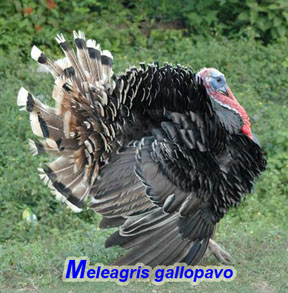
Anyway, that's my hypothesis in brief. Oh, and one more thing: why the turkey at the head of this post? To commemorate Thanksgiving, of course, but also because turkeys are known to exhibit significant numbers of parthenogenesis. That is, a significant proportion of male turkeys are the result of the development of an unfertilized egg. They are male, not female (as would be the case in parthenogenetic mammals) because males are the homogametic sex in birds; they are ZZ, whereas females are ZW (the Z and W chromosomes corresponding in function to the X and Y chromosomes in mammals). It has not escaped my notice that parthenogenesis would greatly facilitate the kind of chromosomal speciation I have outlined above. Hence, the turkey can stand as an emblem of the First-Degree Inbreeding Hypothesis for Chromosomal Speciation in Animals.

Have a great turkey day, folks!

Comments, criticisms, and suggestions are warmly welcomed!

--Allen

Unraveling Where Chimp And Human Brains Diverge


SOURCE: Terra Daily News

COMMENTARY: Allen MacNeill

Just in time for our discussion of human-chimpanzee differences in our evolution course at Cornell, here is an article describing recent research into how human an chimpanzee brains differ. Commentary follows:

Los Angeles CA (SPX) Nov 14, 2006: Many of the human-specific gene networks identified by the scientists related to learning, brain cell activity and energy metabolism.

Six million years ago, chimpanzees and humans diverged from a common ancestor and evolved into unique species. Now UCLA scientists have identified a new way to pinpoint the genes that separate us from our closest living relative - and make us uniquely human. The Proceedings of the National Academy of Sciences reports the study in its Nov. 13 online edition.
"We share more than 95 percent of our genetic blueprint with chimps," explained Dr. Daniel Geschwind, principal investigator and Gordon and Virginia MacDonald Distinguished Professor of Human Genetics at the David Geffen School of Medicine. "What sets us apart from chimps are our brains: homo sapiens means 'the knowing man.'

"During evolution, changes in some genes altered how the human brain functions," he added. "Our research has identified an entirely new way to identify those genes in the small portion of our DNA that differs from the chimpanzee's."

By evaluating the correlated activity of thousands of genes, the UCLA team identified not just individual genes, but entire networks of interconnected genes whose expression patterns within the brains of humans varied from those in the chimpanzee.

"Genes don't operate in isolation - each functions within a system of related genes," said first author Michael Oldham, UCLA genetics researcher. "If we examined each gene individually, it would be similar to reading every fifth word in a paragraph - you don't get to see how each word relates to the other. So instead we used a systems biology approach to study each gene within its context."

The scientists identified networks of genes that correspond to specific brain regions. When they compared these networks between humans and chimps, they found that the gene networks differed the most widely in the cerebral cortex -- the brain's most highly evolved region, which is three times larger in humans than chimps.

Secondly, the researchers discovered that many of the genes that play a central role in cerebral cortex networks in humans, but not in the chimpanzee, also show significant changes at the DNA level.

"When we see alterations in a gene network that correspond to functional changes in the genome, it implies that these differences are very meaningful," said Oldham. "This finding supports the theory that variations in the DNA sequence contributed to human evolution."

Relying on a new analytical approach developed by corresponding author Steve Horvath, UCLA associate professor of human genetics and biostatistics, the UCLA team used data from DNA microarrays - vast collections of tiny DNA spots -- to map the activity of virtually every gene in the genome simultaneously. By comparing gene activity in different areas of the brain, the team identified gene networks that correlated to specific brain regions. Then they compared the strength of these correlations between humans and chimps.

Many of the human-specific gene networks identified by the scientists related to learning, brain cell activity and energy metabolism.

"If you view the brain as the body's engine, our findings suggest that the human brain fires like a 12-cylinder engine, while the chimp brain works more like a 6-cylinder engine," explained Geschwind. "It's possible that our genes adapted to allow our brains to increase in size, operate at different speeds, metabolize energy faster and enhance connections between brain cells across different brain regions."

Future UCLA studies will focus on linking the expression of evolutionary genes to specific regions of the brain, such as those that regulate language, speech and other uniquely human abilities.

COMMENTARY:

Sounds to me like the differences are probably the result of different patterns of gene regulation in humans and chimps, rather than entirely different coding regions in the DNA of the two species. In other words, we share a common set of genes for making our brains, but those genes are regulated differently in the two species. This would explain a lot: why, for example, there is so little difference between human and chimp DNA, and how the two species could have diverged so quickly from a common ancestor six million years ago (or less, as some of the archaeological data seem to indicate).

It will be very interesting to see how this story develops, as we get higher and higher resolution "maps" of human and chimp brains and the genetic mechanisms that produce them.

--Allen