Cornell Summer Session Evolution Courses


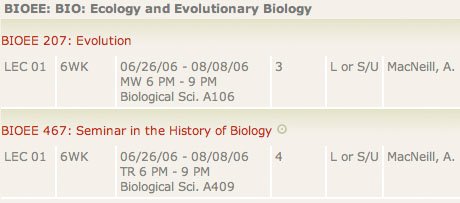
Several people have emailed me requesting information on the Cornell summer seminar on design and purpose in nature. In particular, there seems to be some confusion about the course title and description as it is listed in the online course catalog for the Cornell Summer Session. Here is a link to the page in which the course listing can be found (scroll down to Ecology and Evolutionary Biology/E&EB):

Evolution & Design: Is There Purpose in Nature?

and here is a link to the actual course description:

Course Description

As you can see, the course description in the online catalog is very brief and pretty generic, and the course title ("Seminar in History of Biology") doesn't mention design or purpose. Fear not! This is the correct course listing for the now somewhat notorious "design/purpose in nature seminar."

And, of course, please consider taking my introductory evolution course as well! We will be covering some of the same topics, and will take a historical and philosophical approach to the science of evolution. The class is generally small enough so that there is plenty of interaction between students and instructors (I usually have a couple of graduate student TAs), and we learn a lot about evolution and its implications (and have fun doing it).

There will also be a "course blog", which will be announced on this website soon. Watch this space!

--Allen

Cornell Daily Sun: Seminar Promises Intelligent Design Discussion


ARTICLE: Seminar Promises Intelligent Design Discussion

AUTHOR: Nadia Chernyak, Cornell Daily Sun Contributor

SOURCE: Cornell Daily Sun

COMMENTARY: Allen MacNeill (following the article)

Prof. Allen MacNeill, biology, will be offering a course about Intelligent Design, entitled "Evolution and Design: Is there a Purpose in Nature?". The course will be offered seminar-style over the summer of 2006, through the ecology and evolutionary biology, history and science and technology studies departments as well as the biology and society program.

The syllabus requires texts from authors both for and against intelligent design and includes optional texts, one of which is by Charles Darwin.

MacNeill first came up with the theme for the seminar when brainstorming with Prof. Will Provine, ecology and evironmental biology, for topics for this summer's seminar class. MacNeill says that the idea was inspired by the Kitzmiller v. Dover case, in which the Dover Area School District in Dover, Pa. was sued for requiring the teaching of intelligent design in high school science classes.

"Given the Dover case, [Provine and I] thought it'd be interesting to teach [this year's seminar] on Intelligent Design," MacNeill said.

MacNeill labels himself a "very vehement critic" of intelligent design but hopes to inspire debate and controversy in his classroom.

"I'm hoping I get people from both sides so that the discussion will be animated. The worst thing you can have is a dull seminar, which is what you have when people have the same belief or don't believe in anything," he said.

As part of the attempt to present both sides of the issue, MacNeill has also invited Hannah Maxson '07, president of the Intelligent Design and Evolution Awareness club, to help with the class. Questions from the students about books by Intelligent Design proponents will be fielded by Maxson. The class is currently capped at eighteen to keep it discussion-based, not a lecture, says MacNeill.

It appears that this is not MacNeill's first delve into the topic of Intelligent Design. MacNeill is also on the IDEA list-serve, keeps consistent email correspondence with the club, holds debates about the issue and has invited the IDEA president to give a lecture in one his classes last year. MacNeill describes his relationship with the IDEA club as an "agreement in a very courteous manner to disagree."

"I'm glad it's being offered," said Maxson. "Intelligent Design needs to be discussed more in academia and not just [as] some 'frightening political movement' that needs to be stopped."

Hannah is currently working with MacNeill to pull together intelligent design articles for the reading list. She's also been invited to the discussions once the class starts to help "provide a cogent case for Intelligent Design theory."

IDEA Executive Director Seth Maxson also gives approval, saying that this "is an example of Intelligent Design being accepted as an intriguing scientific theory by the wider academic community."

Enrollment prospects are also looking up. Seth claims to have already talked with a few students who plan to take the class.

"They all seem very excited," he said.

Despite said excitement, MacNeill appears to have been met with some skepticism from colleagues. Since announcing what his class will be about, MacNeill has received many questions and comments both from students and professors via his personal blog. "Evolutionary biologists tended to be more negative about the course [than Intelligent Design advocates]," MacNeill said.

MacNeill also said that two colleagues have stated that the course shouldn't be offered in biology.

"I respectfully disagree," he said. "Most people in biology have a strong opinion on this, mostly negative. The knee-jerk response is to call the other side ignorant or dishonest; my experience is that that doesn't address the issue."

Though MacNeill claims to be "strongly skeptical of Intelligent Design, at the very least", he says he is not worried about one-sided enrollment.

"What's exciting for me is people taking strong positions. I hope students who haven't made up their minds make up their minds on the subject."

The class will require a detailed research paper in which the student must argue his/her position on the matter.

"Personally I believe if you do that you reject the idea," he chuckled. "But I find sometimes that that's not the case."

MacNeill has no immediate or definite plans to continue this class in the future, claiming that he would like to do other topics such as ethics and the question of free-will. However, there is some room for compromise.

"As long as Intelligent Design is in the news, maybe it makes sense to continue to do this," MacNeill said.

********************************************************************************
COMMENTARY:

Not a bad article, especially for the Sun. From all indications, it now appears that most attempts to "spin" the course in favor of intelligent design have fizzled out, and the true nature of the course is now apparent: as I have posted multiple times before, we will be reading about and discussing various concepts of purpose in nature and their relationship to evolutionary theory, including intelligent design theory. All of these concepts will be examined critically with a view toward determining which (if any) have an impact on the science of evolutionary biology, and what philosophical implications the current theory of evolution has for concepts of purpose in nature.

Not as outrageous or exciting as some of the early press reports would have you believe, but more interesting to me and (I hope) to the students who have already expressed an interest in the course.

--Allen

Is Intelligent Design Distinguishable from Deism?

SOURCE: Dispatches from the Culture Wars

COMMENTARY: Allen MacNeill

There is a very interesting thread at Dispatches from the Culture Wars on the difficulty (and importance) of distinguishing between deism and "intelligent design theory (IDT)." Specifically, there is a long discussion between several posters on whether IDT is fundamentally different from “theistic evolutionary theory (TET)” (which is, IMO, indistinguishable from simple deism).

In particular, several of the posters have argued that if IDT and TET are equivalent, then there is literally no science in IDT at all. That is, if God (remember, as I have posted earlier, it’s easier and more intellectually honest to type "God" than “the intelligent designer”) created the universe with just exactly the right set of natural laws that things like the bacterial flagellum could have evolved by purely natural processes alone (i.e. without further supernatural intervention), then that version of IDT is indistinguishable from deism (DEI). In that event, both would be entirely without scientific value, since both IDT and DEI would thereby accept the operation of all natural laws as both necessary and sufficient to produce all natural objects and processes.*

This means that if we are to distinguish between IDT and DEI (and, by extension, from TET) it must be incontrovertably shown that natural laws as they now exist are insufficient to produce existing natural objects and processes. As many others have pointed out, this requires proving a negative. That is, unless we assume that all currently known natural laws are literally all there are or even can be (as Lord Kelvin infamously did at the end of the 19th century), then it is possible that in the future new versions of purely natural laws will be discovered that can explain the existence of those entities now claimed to be possible only through supernatural intervention.

This, of course, leads to all kinds of logical fallacies, chief among them the problem of “supernatural incompetence.” If IDT = DEI = TET, then God is indeed omnipotent and can create natural laws that make the evolution of all natural entities possible without further intervention. In that case, IDT, DEI, and TET are indistinguishable from each other and none add anything of use to the generally accepted methods and principles of empirical science. This means that nothing more need be said about them by scientists, and we can go on doing science (including evolutionary biology) the way we have been doing up until now.

However, if IDT is not DEI nor TET, then perforce God must not be omnipotent. That is, He cannot create a set of natural laws that can in the fullness of time produce the objects and processes we observe around us.

Therefore, it seems to me that there are only two logical positions to take on this subject:**

1) God is omnipotent and therefore created the universe with natural laws of sufficient power and subtlety to allow purely natural processes to produce all natural objects (and therefore IDT is unnecessary).

or

2) God is not omnipotent and therefore cannot create a universe in which natural laws are sufficient to produce all natural objects and processes. This means that God (who is, by definition, incompetent) must intervene at specific times and places to alter nature in direct contravention of His originally created (and incompletely effective) natural laws.

These two positions have obvious and devastating implications for theology as well:

If (1) is the case, then God is only relevent to nature during it creation. From then on, He does not participate in it in any material way (and therefore prayer is useless, as all intercession by God violates His original created order), or

If (2) is the case, then God has left incontrovertable evidence of both His existence and actions in the structure of nature itself, and therefore faith is no longer necessary (and both justification and salvation through faith are pointless).

--Allen

*It also seems that this version of deism is indistinguishable from what some ID theorists (including Michael Behe) are now referring to as "front-loaded" IDT (FLIDT). That is,

FLIDT = DEI = TET

all of which are irrelevent for and useless to science.

**Alert readers may notice that there is a third option: God is omnipotent, but chooses to create a universe in which His natural laws are insufficient to produce all natural objects and processes without his intervention. This strongly implies that God is either meddlesome or capricious (or both), conclusions that I suspect would not be palatable to most ID theorists, deists, or theistic evolutionists.

More on Parsimony in Biology


AUTHOR: Robert Skipper

SOURCE: Cladistic Parsimony and Ockham's Razor

COMMENTARY: Allen MacNeill

Robert Skipper has a report on his participation in the Southern Society for Philosophy and Psychology conference last weekend. He delivered a paper on Cladistic Parsimony and Ockham's Razor, a subject about which both he and I have blogged in the past. In a previous post, Skipper comes to the following (admittedly tentative) conclusions:

At the moment, my thinking is that cladistic parsimony is a special case of simplicity (if it is a case at all). But I won't make the case for that here....One thing I think we can say, from the examples, is that when we're in a situation in which we must choose among competing hypotheses or theories, and empirical evidence isn't definitive, use simplicity to make the choice.

Each of [the authors cited] urge us to run with the simplest model among the relevant alternatives unless we're forced to abandon that model for a more complicated one. What does the forcing is empirical evidence. Indeed, none of the biologists I quoted above said anything about the fact that simplicity is truth-indicative. Burnet in fact said that because the clonal theory is simplest, it's probably false! So, simplicity doesn't indicate the truth of some hypothesis or model or theory. Rather, it's a strategy that directs us toward the truth....At least we can say we've eliminated some fruitless paths of inquiry.


COMMENTARY:

I think it would be helpful to consider two possibilities vis-a-vis the application of parsimony in science:

1) Parsimony is merely "useful" in the sense that it reduces the complexity of hypotheses to a level at which they are empirically testable. When I teach my students about how science is usually done, I give them the "hypothetico-deductive" model first, and then point out that this model doesn't give you criteria for formulating testable hypotheses, it only gives you a method for testing them once they have been formulated. To formulate testable hypotheses requires an additional step: one must "mentally" test one's hypothesis to determine if:
• it's empiirically testable, and
• the emipirical test that one is considering can distinguish between it and alternative hypotheses
If the answers to these two questions are both "yes," then one is ready to actually run the experiment/make the observations to test the predictions that flow from the hypothesis.

In this view, parsimony is simply "useful" in that it is more likely (on average) to yield testable hypotheses whose empirical results are more likely to unambiguously validate or falsify one's predictions.

2) Parsimony might actually be an intrinsic feature of "natural causation" itself. In evolutionary psychology (my field, BTW) there is a concept known as "computational overload (CO)." Basically, CO is used as an argument against the "blank slate" hypothesis for human cognition and motivation. That is, if the mind is a "blank slate" (i.e. relies entirely on "trail and error/reinforcement" algorithms), CO rapidly overwhelms even the largest and fastest computer imagineable. Therefore, EPs like me assume that the brain is modularized, and that each module has a fairly stringent "perceptual filter" that limits inputs as a way of minimizing CO (such filters and modules having evolved by natural selection).*

The same concept could be applied to nature, and especially biology. Biological systems are fiendishly complex, much more so than physical or chemical systems. This complexity, if not minimized in some way, would result in biological systems "seizing up" as the result of CO (where "computation" is interpreted broadly as the binary and higher level interactions between multiple influences, some competing and some complementary).

Natural selection, in other words, has resulted in the evolution of biological systems in which "parsimony" has been encoded into the interactive structure of living organisms and systems of living organisms themselves, as a way of minimizing CO and maximizing effective interaction with one's environment.

Indeed, I would be tempted to argue that (1) may even be a consequence of (2), as our minds themselves are already adapted to minimizing CO, and therefore are predisposed to parsimonious solutions to problems in general, and therefore also scientific problems. In our interactions with nature as in our science, therefore, "good enough for now" is "good enough for all".
--Allen

*I also suspect that this phenomenon is the basis for the "Fundamental Attribution Error (FAE)" in humans, as a predisposition for making FAEs would be selected for as long as the results of doing so were as often adaptive as deleterious (i.e. a tendency toward "false positives" in making FAEs would simply be a kind of "worse case analysis", which is almost always adaptive...especially in a dangerous world such as ours, in which even paranoids have real enemies ;-)

Teleological and Teleonomic: A New(er) Analysis


AUTHOR: Ernst Mayr

SOURCE: Boston Studies in the Philosophy of Science, Volume XIV, pages 91 -117

COMMENTARY: Allen MacNeill

On April 17, 2006 04:35 PM David B. Benson wrote in the Panda's Thumb (scroll way down):

[Can you] explain why you state that ant colonies, cities, and other emergent organizations have purpose? In particular, what is wrong with mere teleomentalism, that an ascription of purposeful behavior is only metaphor?


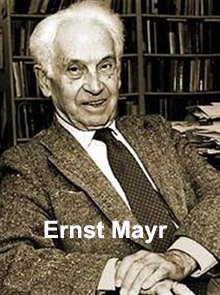
Ernst Mayr [1] distinquished between two different kinds of natural processes that appear to be “goal directed”:

Teleomatic processes: Processes that simply follow natural laws, i.e. lead to a result consequential to concomitant physical forces, and the reaching of their end state is not controlled by a built-in program. The law of gravity and the second law of thermodynamics are among the natural laws which most frequently govern teleomatic processes. Examples include the cooling to ambient temperature of a red hot bar of iron and the falling of a rock to the ground.

Teleonomic processes: Processes that owe their goal-directedness to the operation of a program. The term teleonomic implies goal-direction. This, in turn, implies a dynamic process rather than a static condition, as represented by a system. Examples include the development of an adult organism from a fertilized zygote and the building of a dam by beavers.

Mayr argues very strongly that the common use of teleological language by biologists is legitimate because it recognizes the goal-directedness of biological processes. He also stresses that, although many biological processes (such as ontogeny) are clearly goal-directed, they owe their goal-directedness to the operation of programs, such as the genetic program encoded in the DNA. He concludes that although such programs themselves are goal-directed (i.e. purposeful), the process by which such programs have come into being – evolution by natural selection – is NOT itself goal directed.

[ I would state this slightly differently from Mayr: that there is no observable evidence that the evolutionary processes by which such programs come into being are goal-directed (i.e. “designed” or “purposeful”). Therefore, although such purposes may exist, they are invisible to us on principle and therefore irrelevent to scientific explanations of natural phenomena.]

Mayr concludes:

• The use of so-called teleological language by biologists is legitimate; it neither implies a rejection of physico-chemical explanation nor does it imply non-causal explanation

• At the same time, it is illegitimate to describe evolutionary processes or trends as goal-directed (teleological). Selection [reifies] past phenomena (mutation, recombination, etc.), but does NOT plan for the future, at least not in any specific way [as far as we can tell]

• Processes (behavior) whose goal-directedness is controlled by a program may be referred to as teleonomic

• Processes which reach an end state caused by natural laws (e.g. gravity, second law of thermodynamics) but not by a program may be designated as teleomatic

• Programs [of the type described above] are in part or entirely the product of natural selection

• Teleonomic (i.e. programmed) behavior occurs only in organisms (and man-made machines) and constitutes a clear-cut difference between the levels of complexity in living and in inanimate nature [i.e. they are “emergent properties” of living systems, not present in the non-living materials of which living organisms or their artifacts are composed]

• Teleonomic explanations are strictly causal and mechanistic. They give no comfort to adherents of vitalistic concepts [including supporters of “intelligent design,” if such supporters believe that the kinds of programs desctibed above come into existence as the result of a purposeful process]

• The heuristic value of the teleological Fragestellung makes it a powerful tool in biological analysis, from the study of the structural configuration of macromolecules up to the study of cooperative behavior in social systems.

COMMENTARY:

I agree with Mayr on virtually every point. In other of his publications, Mayr argues strongly for the idea that biological systems exhibit “emergent properties,” and that this is one of the primary differences between biology and the other natural sciences, such as physics. At the same time (and contra some supporters of “emergent properties,” such as Andrew North Whitehead and Teilhard de Chardin), Mayr argues very strongly for the naturalist position that such properties are well within both the darwinian paradigm and the tradition of naturalistic explanation that underlies the natural sciences.

Given the foregoing, I therefore believe that the kind of teleonomy exhibited by ants and ant colonies is indeed a natural property of such biological systems, and not just a “teleomentalism” (i.e. a semantic distinction rooted in human language and cognition, having no actual reality in nature). Furthermore, it seems to me that the kinds of advances that we have seen since Mayr wrote his paper – developments in artificial intelligence and the programming of cybernetic “expert systems”, advances in genetics, and especially a much deeper understanding of the processes of evolutionary development – lend support to Mayr’s analysis, and that using Mayr’s theoretical framework can not only assist people working in the aforementioned fields, it can also lead to some clarity in understanding the origin and evolution of purpose in nature.

This analysis leaves us with the following problem: Is the term "teleology" an umbrella term that subsumes both teleomatic and teleonomic processes, and if so, what term is most appropriate for the kinds of unambiguously goal-directed behavior exhibited by humans (and our artifacts, such as heat-seeking missiles)? My preference is to reserve the term "teleology" for the latter (i.e. clearly goal-seeking processes initiated and controlled by rational entities, such as ourselves), and apply the terms teleonomy and teleomatic the way Mayr suggests in his article.

I believe that these distinctions clearly and unambiguously distinguish between natural processes that appear to be (or even are) goal-directed, such as ontology, and processes that are not, such as natural selection and other evolutionary mechanisms.

And yes, before an ID supporter points out the obvious, the foregoing analysis doesn't eliminate the problem of evolution versus ID, since ID theorists can still argue that God (remember, I asserted a while back that I will use the proper/role name "God" instead of "the intelligent designer"...it requires fewer keystrokes and is more honest IMHO) both "designed" and "guided" the processes by which Mayr's "programs" bring about teleonomic goal-seeking behavior.

But that discussion will have to wait for another post...

REFERENCES CITED:

[1] (Mayr, E. (1974) “Teleological and Teleonomic: A New Analysis.” Boston Studies in the Philosophy of Science, Volume XIV, pages 91 -117),

Riding the Evolution-Design Roller Coaster


[Scroll Down For Update]

This has certainly been an educational experience...but what else should one expect at Cornell? The past week has been a roller coaster of media attention, not to mention extreme reactions from both sides of the issue. What started out as an act of kindness toward an old and dear friend (my colleague and mentor, Will Provine, who was originally scheduled to teach this course), turned into a media circus, conducted almost entirely online. Here's the backstory:

For years Will Provine and I have been teaching an undergraduate seminar in the Cornell Summer Session entitled "Seminar in History of Biology." Between ourselves, we have always called the course "philosophical implications of evolution," and have always thought of it in those terms. The course description stayed the same from year to year, but the focus of the course changed, depending on what we found most interesting to discuss with our students. For the past few years, Will has focussed on the implications of evolution for the concept of human free will. When I taught the course, I focused on three topics: the implications of evolution for free will, purpose, and ethics.

Last fall, when we began talking about the focus of the course for this summer, Will (who was scheduled to teach the course) decided to focus exclusively on "intelligent design theory." Anyone who knows Will (or me, for that matter) knows that he always invites people from the opposing side to make a presentation in his course. He has debated Phillip Johnson several times, both at Cornell and Stanford, and several ID theorists (including Michael Behe and John Stanford) have made presentations in his large evolution course at Cornell. And so, since we both know the students in the Cornell IDEA Club, we planned to contact them and see if they would be interested in participating in some way in the seminar course this summer.

Then tragedy struck in Will's family, and he was unable to committ to teaching the seminar this summer. He asked me to fill in for him, and I agreed to do so. I went ahead with our plans to invite the Cornell IDEA folks to participate and submitted the course description and reading list to the department and to the Summer Session.

The Cornell IDEA Club then posted a notice on their blog about the course, pointing out that it would be a seminar in which intelligent design theory would be discussed in the larger framework of its relationship to evolutionary theory. However (perhaps because of the source), this was immediately picked up by several websites supporting ID (most notably World Net Daily) and spun as "Cornell to Offer Course in Intelligent Design."

And that was when the roller coaster crested the top of the "pull" hill and started its free roll down. The Site Meter hit counter at the bottom of my blog, which had been reading < 50 hits/day jumped to > 600 hits/hour. I was unaware of this until I glanced at it early Monday morning and was non-plussed...what in the world was happening? By Tuesday, the spin had become positively centrifugal: the course, the proposed content, the reading list, the venue, and everything else about the course (including my personal character) were being debated by literally thousands of people who knew absolutely nothing about me nor (apparently) about the course.

Luckily my Site Meter shows referrals, and so I quickly found out where most of the traffic to my site was coming from and posted much more detailed clarifications of the course, mostly for the benefit of the vast army of people who don't know me nor where I stand on the issues. The result has been very interesting: although there is less euphoria among the ID supporters, there is respect for the fact that the course is intended to be a forum for free and open discussion on the topic of purpose in nature, with ID as one of the principle examples.

But not the only one, of course. As I pointed out in the course description, the concept of purpose is one that evolutionary biologists have debated and investigated for almost two centuries. Darwin himself talked about the idea of purpose in nature, in both the Origin of Species and The Descent of Man. No less eminent an evolutionary biologist than Ernst Mayr wrote several important papers on the subject, responding to other papers by such luminaries in the field as Francisco Ayala, Colin Pittendrigh, and William Wimsat. Philosophers have also weighed in on the issue, beginning with Aristotle and including Andrew Woodfield, Ernst Nagel, and, most recently, Michael Ruse.

Most disconcerting to me were some of the early comments from evolutionary biologists, who asserted that ID should not even be mentioned in a course in evolutionary biology. Well, I not only teach a course on evolution, I also sit in on the other introductory evolution courses at Cornell and elsewhere, and ID theory is mentioned in all of them. True, it is mentioned in the context of an alternative explanation for adaptation in nature, one that is far outside the boundaries of mainstream science, but mentioned none the less.

The difference between what happens in a lecture course on evolution and what will happen this summer in the seminar course is that, rather than lecturing on the subject, I will (as always) invite the participants in the seminar to inform themselves about the subject and discuss it with as much clarity and vigor as they can muster. I believe (based on past experience) that when the cases for ID and evolutionary biology are fully and fairly made in this way, evolutionary biology will be the winner. After all, it has mountains of empirical evidence to back it up, and empirical evidence is the basis for all of science, as far as I understand it.

In answer to some of my critics from evolutionary biology, therefore, I feel that it is very appropriate for this kind of discussion to take place in a science course, rather than just a history or philosophy of biology course. Students, including science majors, are far too often not given enough credit for their ability to both formulate and judge rational arguments in a free and open forum of ideas. Despite the fact that the topic is ostensibly the philosophy of science, the debate over the validity of ID versus evolutionary theory is fundamentally a scientific debate. If scientists refuse to debate the subject, we will leave the floor open for not-quite-science, pseudoscience, and (worst of all) anti-science to claim victory, and believe me that will be what the general public perceives the ID community has achieved.

Furthermore, the paradox of purpose in nature is one that has not yet been solved by evolutionary biologists. What are evolutionary adaptations if not structural and functional characteristics that serve a purpose in the life of an organism? While it sounds silly to say that rocks fall "in order to" reach the ground, it doesn't sound silly to say that the heart pumps the blood "in order to" circulate it throughout the body. The debate over such explanations is not just semantic, and as Ernst Mayr pointed out in several articles and his book Toward a New Philosophy of Biology, focussing on the "purposefulness" of adaptations has important implications for evolutionary biology, as well as such diverse fields as cognitive psychology, epistemology, and the development of "expert" computer systems (not to mention "smart weapons" like the eminently teleological "Sidewinder" missile).

So, we shall proceed this summer, a little less naive about the "culture wars", but firmly in the belief that courteous, rational, informed discussion is the only reliable way to truth. And then, when we come to the end, we can step off the roller coaster, take a deep breath, and go look for a cotton candy stand.

UPDATE (as of Mon17Apr06@16:59EST)
After a week of riding the roller coaster, several discussions stand out as representing where things were and are (and probably will be, once the course actually starts). Here they are (be sure to scroll down and read the comments):

Design Paradigm: Evolution and Design

Design Paradigm: Teaching ID

Design Paradigm: Why Teach Design

Panda's Thumb: Comments on "Riding the Evolution-Design Roller Coaster"

Panda's Thumb: Neutrality, Evolution, and ID

Sounding the Trumpet: Cornell Offers First Class on Intelligent Design

Telic Thoughts: Cornell Offers Course on Intelligent Design I

Telic Thoughts: Cornell Offers Course on Intelligent Design II

Uncommon Descent: ID at Cornell, John Sanford and Allen MacNeill

Evolution and Design: What Will the Course be About?


ARTICLE: Cornell to Offer Class on Intelligent Design

SOURCE: The Associated Press

COMMENTARY: Allen MacNeill (following the article)

ITHACA, N.Y. (AP) — Cornell University this summer will offer a class on intelligent design, a theory that has sparked heated debate around the country on whether alternatives to evolution should be taught in public schools.

The course will include texts that oppose and support the theory of intelligent design and will be offered through the undergraduate biology program. It will be a history of biology class that looks at ethics and philosophy.

"I'm not going to be bashing (intelligent design), but I'm also not going to be advocating it," said lecturer Allen MacNeill, an evolutionary biologist who will teach the course. "I'm going to be using it — and evolutionary biology too — to think about these very complicated ideas."

Cornell President Hunter Rawlings III in an Oct. 21 speech condemned the teaching of intelligent design as science, calling it "a religious belief masquerading as a secular idea."

Intelligent design is a theory that argues that life is too complex to have developed through evolution, implying a higher power must have had a hand. It has been harshly criticized by The National Academy of Sciences and the American Association for the Advancement of Science, which have called it repackaged creationism.

Around the country, attempts to introduce public school students to alternatives to evolution such as intelligent design have largely failed.

Hannah Maxson, president of the Intelligent Design Evolution Awareness Club at Cornell, said she is glad the issue is being taken seriously.

"We'd just like a place at the table in the scientific give-and-take," she said.

********************************************************************************
COMMENTARY:

Let me assure my faithful readers that I am not “teaching intelligent design” at Cornell Univesity this summer. Rather, I am offering a seminar course in which the participants (including me) will attempt to come to some understanding vis-a-vis the following:

As Ernst Mayr pointed out in his 1974 paper (”Teleological and Teleonomic: A New Analysis.” In Boston Studies in the Philosophy of Science, Volume XIV, pages 91 -117), it may be legitimate for evolutionary biologists to refer to adaptations as teleological. However, such adaptations have evolved by natural selection, which itself is NOT a purposeful process. Therefore, we have a fascinating paradox: purposefulness can evolve (as an emergent property) from non-purposeful matter (and energy, of course) via a process that is itself purposeless (as far as we can tell). This immediately suggests the following questions:

• Is there design or purpose anywhere in nature?
• If so, are there objective empirical means by which it can be detected and its existence explained?
• Can the foregoing questions be answered using methodological naturalism as an a priori assumption?
• What implications do the answers to these questions have for science in general and evolutionary biology in particular?

To answer these questions, we will read several books and a selection of articles on the subject of design and purpose in nature (the course description is available here). As you can see from the reading list, we will be looking at all sides of this very challenging issue. My own position is very strongly on the side of evolutionary biology (i.e. in the tradition of “methodological naturalism”). Consequently, I disagree very strongly with the positions of Michael Behe, William Dembski, Phillip Johnson, and other representatives of the Discovery Institute. I will therefore be attacking both their positions and the metaphysical assumptions upon which they are based with as much logic and vigor as I can muster. At the same time, I have invited members of the Cornell IDEA Club to participate in the course and to explain and defend their beliefs and positions. From my previous interactions with them, I expect that they will make an equally forceful and well-argued case for their position. The students taking the course will be expected to follow the arguments, participate in them, and come to their own conclusions, which they will then be required to defend to the rest of us. Regardless of whether they agree with me or with my opponents, their work will be judged on the basis of logical coherence and marshalling of references in support of their arguments.

As to the question of whether “intelligent design theory” is worthy of study (and is especially appropriate for a science-oriented seminar course), I have several reasons to believe that it is:

First, by clearly drawing a distinction between the traditional scientific approach (i.e. “methodological naturalism”) and the “supernaturalist” approach, we can clarify just what science is capable of (and what it isn’t). Like Ernst Mayr, I believe that the question of the existence of design or purpose in nature can ultimately be answered without resort to supernatural explanations. Indeed, as an evolutionary psychologist, I believe that we do have the ability to recognize design and purpose in nature (and to act purposefully ourselves), and that this ability is the result of natural selection. That is, both of these abilities have adaptive value in a world in which some phenomena are not designed and/or purposeful and others are (the latter having potentially fatal consequences if unrecognized).

Secondly, by studying what I believe to be a flawed attempt at identifying and quantifying design or purpose in nature, we may be able to do a better job of it. Clearly, there are purposeful entities capable of “intelligent design” in the universe: I am one and I infer that you are another. There are also objects and processes that clearly are not: the air we are both currently breathing clearly fall into this class. As a scientist committed to naturalistic explanations for natural phenomena, it is clear to me that there must be some way of discerning between these two classes of objects and processes, as both of them are clearly “natural.” Therefore, we will use several approaches to the identification and explanation of design and purpose to do so.

Thirdly, the recent resurrection of “intelligent design theory” has historical and political, as well as scientific roots. By studying these, we can learn better how science proceeds, how scientific hypotheses are tested, and how scientific theories are validated (and invalidated). In my opinion, “intelligent design theory” as it is currently promulgated falls far short of the criteria for natural science, but is very useful at demonstrating how to distinguish between science and pseudoscience.

Finally, the question of design and purpose in nature is one that goes back to the foundation of western philosophy. The Ionian philosophers - Thales, Anaximander, Democritus, Epicurus, and their Roman descendant Lucretius - were the first people in recorded history to assert that nature can be explained without reference to supernatural causes. Their ideas were overshadowed by the academy of Plato and his student, Aristotle, who proposed that supernatural and teleological causes were primary. Darwin revolutionized western science because he completed the subversion of the Platonic/Aristotelian world view, replacing it with a naturalistic one much more like that of the Ionians. It is this tradition we will investigate, and which I hope we can in some way emulate this summer.