A Third Way: James Shapiro and the Post-Modern Synthesis


AUTHOR: James A. Shapiro

SOURCE: The Boston Review

COMMENTARY: Allen MacNeill (following the article)

The recent reviews in your columns of books by Dennett, Dawkins, and Behe are testimony to the unflagging interest in controversies about evolution. Although such purists as Dennett and Dawkins repeatedly assert that the scientific issues surrounding evolution are basically solved by conventional neo-Darwinism, the ongoing public fascination reveals a deeper wisdom. There are far more unresolved questions than answers about evolutionary processes, and contemporary science continues to provide us with new conceptual possibilities.

Unfortunately, readers of Boston Review may remain unaware of this intellectual ferment because the debate about evolution continues to assume the quality of an abstract and philosophical "dialogue of the deaf" between Creationists and Darwinists. Although our knowledge of the molecular details of biological organization is undergoing a revolutionary expansion, open-minded discussions of the impact of these discoveries are all too rare. The possibility of a non-Darwinian, scientific theory of evolution is virtually never considered. In my comments, then, I propose to sketch some developments in contemporary life science that suggest shortcomings in orthodox evolutionary theory and open the door to very different ways of formulating questions about the evolutionary process. After a discussion of technical advances in our views about genome organization and the mechanisms of genetic change, I will focus on a growing convergence between biology and information science which offers the potential for scientific investigation of possible intelligent cellular action in evolution.

The past five decades of research in genetics and molecular biology have brought us revolutionary discoveries. Upsetting the oversimplified views of cellular organization and function held at mid-century, the molecular revolution has revealed an unanticipated realm of complexity and interaction more consistent with computer technology than with the mechanical viewpoint which dominated the field when the neo-Darwinian Modern Synthesis was formulated. The conceptual changes in biology are comparable in magnitude to the transition from classical physics to relativistic and quantum physics.

Four categories of molecular discoveries are especially important in opening up exciting new ways of thinking about the biological processes that underlie evolutionary change.

(1) Genome Organization. Our current ideas of genome organization are completely different from the "beads on a string" view that dominated genetics in the 1940s and 1950s. At that time genes were "units" which corresponded to individual organismal traits, and the "one gene-one enzyme" hypothesis told us that the essential business of each gene was to encode a specific protein molecule linked to a particular phenotype. We have now deconstructed each genetic locus into a modular assembly of regulatory and coding motifs. Most of these motifs are shared among many loci, suggesting that genomes are assembled Lego-like from a repertoire of more basic sequence elements, many of which do not encode proteins but determine other important functions (transcription, translation, RNA processing, DNA replication, chromatin condensation, etc.). As we analyze genome expression during cellular proliferation and multicellular development, we have learned that diverse genetic loci are organized hierarchically into interconnected genome-wide networks which function dynamically. Not confined to a single pathway, many genetic loci are active at different times, participating in the expression of more than one phenotypic trait. Comparisons of genomes in different organisms have revealed unexpected patterns of evolutionary conservation across large taxonomic distances, while closely-related genomes frequently differ significantly in the arrangement of repetitive DNA elements which do not encode proteins.

How all of this modularity, complexity, and integration arose and changed during the history of life on earth is a central evolutionary question. Localized random mutation, selection operating "one gene at a time" (John Maynard Smith's formulation), and gradual modification of individual functions are unable to provide satisfactory explanations for the molecular data, no matter how much time for change is assumed. There are simply too many potential degrees of freedom for random variability and too many interconnections to account for.

Studies of the molecular sources of genetic variability have taught us two major lessons about how cells take care of their genomes--one about self-protection, the other about self-reorganization.

(2) Cellular Repair Capabilities. First, then, all cells from bacteria to man possess a truly astonishing array of repair systems which serve to remove accidental and stochastic sources of mutation. Multiple levels of proofreading mechanisms recognize and remove errors that inevitably occur during DNA replication. These proofreading systems are capable of distinguishing between newly synthesized and parental strands of the DNA double helix, so they operate efficiently to rectify rather than fix the results of accidental misincorporations of the wrong nucleotide. Other systems scan non-replicating DNA for chemical changes that could lead to miscoding and remove modified nucleotides, while additional functions monitor the pools of precursors and remove potentially mutagenic contaminants. In anticipation of chemical and physical insults to the genome, such as alkylating agents and ultraviolet radiation, additional repair systems are encoded in the genome and can be induced to correct damage when it occurs.

It has been a surprise to learn how thoroughly cells protect themselves against precisely the kinds of accidental genetic change that, according to conventional theory, are the sources of evolutionary variability. By virtue of their proofreading and repair systems, living cells are not passive victims of the random forces of chemistry and physics. They devote large resources to suppressing random genetic variation and have the capacity to set the level of background localized mutability by adjusting the activity of their repair systems.

(3) Mobile Genetic Elements and Natural Genetic Engineering. The second major lesson of molecular studies into the origins of genetic change is that all cells possess multiple biochemical agents for natural genetic engineering--processes that include the cutting and splicing of DNA molecules into new sequence arrangements. Most frequently, natural genetic engineering capabilities reveal themselves through the activities of mobile genetic elements--DNA structures found in all genomes that can move from one position to another. Mobile genetic elements are the most fluid components of the genome and also the most taxonomically specific. In human cells, mobile elements include retrotransposons, like the half-million or more Alu sequences dispersed over all our chromosomes, as well as the inherited gene fragments which our lymphocytes assemble daily to form active genetic loci encoding the key antigen recognition molecules of our immune system. The biochemical agents of DNA restructuring include the enzymes used in our own genetic engineering for research and biotechnology (nucleases, ligases, reverse transcriptases and polymerases) as well as other proteins that combine to form molecular machines capable of mobilizing different genomic components.

The existence of cellular biochemical activities capable of rearranging DNA molecules means that genetic change can be specific (these activities can recognize particular sequence motifs) and need not be limited to one genetic locus (the same activity can operate at multiple sites in the genome). In other words, genetic change can be massive and non-random. Some organisms, such as the ciliated protozooan Oxytricha, completely reorganize their genetic apparatus within a single cell generation, fragmenting the germ-line chromosomes into thousands of pieces and then reassembling a particular subset of them into a distinct kind of functional genome. Furthermore, natural genetic engineering systems can operate premeiotically during the somatic development of tissues that will ultimately produce gametes. This means that major chromosome reorganizations can be present in multiple gametes. Consequently, the appearance of new genome architectures during evolution is not necessarily limited to isolated individuals.

The discovery that genome reorganization is largely a biological process traces back to Barbara McClintock's pioneering studies of mutation and chromosome rearrangement in maize from the 1940s through the 1960s. She linked these genetic events to changes in the regulation of gene expression programs during plant development. We can now appreciate her tremendous wisdom and foresight by seeing how the Lego-like patterns of integrated genome organization mentioned above could be created by the activity of cellular natural genetic engineering systems. Because, like all cellular functions, natural genetic engineering systems are subject to control circuits, they can be held in abeyance for long periods and then called into action at certain key times. Sometimes these activations can be regularly programmed, as in the development of our immune systems, and sometimes activations can occur in response to crisis, as McClintock documented in maize.

The point of this discussion is that our current knowledge of genetic change is fundamentally at variance with neo-Darwinist postulates. We have progressed from the Constant Genome, subject only to random, localized changes at a more or less constant mutation rate, to the Fluid Genome, subject to episodic, massive and non-random reorganizations capable of producing new functional architectures. Inevitably, such a profound advance in awareness of genetic capabilities will dramatically alter our understanding of the evolutionary process. Nonetheless, neo-Darwinist writers like Dawkins continue to ignore or trivialize the new knowledge and insist on gradualism as the only path for evolutionary change.

(4) Cellular Information Processing. While it is easy to see how advances in our understanding of genome organization and genetic change will impact theories of evolutionary processes, another development in contemporary biology is of less obvious but even more basic relevance. This is the growing realization that cells have molecular computing networks which process information about internal operations and about the external environment to make decisions controlling growth, movement, and differentiation. This realization has come, in large measure, from detailed genetic analysis of cellular processes and multicellular development. The inducible repair systems mentioned above provide a relatively simple, well-studied example. Bacterial and yeast cells have molecules that monitor the status of the genome and activate cellular responses when damaged DNA accumulates. The surveillance molecules do this by modifying transcription factors so that appropriate repair functions are synthesized. These inducible DNA damage response systems are sophisticated and include so-called "checkpoint" functions that act to arrest cell division until the repair process has been completed. When the checkpoints do not function, cell division proceeds before repair is completed, and the damaged cells die or produce inviable progeny. One can characterize this surveillance/inducible repair/checkpoint system as a molecular computation network demonstrating biologically useful properties of self-awareness and decision-making.

There are many other cellular systems that display comparable information-processing capabilities. Fro example, it is now common among molecular biologists who study the cell cycle to speak of various checkpoints (Is DNA replication complete? Are the chromosomes properly condensed and aligned on the metaphase plate?) and decision points (e.g., when to initiate chromosome movement and cytokinesis).

A recent special issue of Scientific American [1] describes beautifully how cancer is now seen as a disease of the molecular information processing routines that ensure orderly cell growth and behavior in the healthy organism. Aberrant tumor cell growth appears to result from at least two kinds of malfunction: the loss of checkpoint controls, or the failure of decision-making routines that dictate programmed cell death (apoptosis) for cells in inappropriate surroundings. During embryonic development, cells make decisions about differentiation based on multiple molecular signals picked up from their environment and from their neighbors by means of surface receptors. These receptors are linked to intercellular molecular cascades called "signal transduction pathways" which integrate the inputs from the receptors to generate appropriate patterns of differential gene expression and morphogenesis of specialized cell structures.

Signal transduction is not limited to multicellular development. We are learning that virtually every aspect of cellular function is influenced by chemical messages detected, transmitted, and interpreted by molecular relays. To a remarkable extent, therefore, contemporary biology has become a science of sensitivity, inter- and intra-cellular communication, and control. Given the enormous complexity of living cells and the need to coordinate literally millions of biochemical events, it would be surprising if powerful cellular capacities for information processing did not manifest themselves. In an important way, then, biology has returned to questions debated during the mechanism-vitalism controversy earlier this century. This time around, however, the discussion is informed by two new factors. One is that the techniques of molecular and cell biology allow us to examine the detailed operation of the hardware responsible for cellular responsiveness and decision-making. The second is the existence of computers and information networks, physical entities endowed with computational and decision-making capabilities. Their existence means that discussing the potential for similar activities by living organisms is neither vague nor mystical.

What significance does an emerging interface between biology and information science hold for thinking about evolution? It opens up the possibility of addressing scientifically rather than ideologically the central issue so hotly contested by fundamentalists on both sides of the Creationist-Darwinist debate: Is there any guiding intelligence at work in the origin of species displaying exquisite adaptations that range from lambda prophage repression and the Krebs cycle through the mitotic apparatus and the eye to the immune system, mimicry, and social organization? Borrowing concepts from information science, new schools of evolutionists can begin to rephrase virtually intractable global questions in terms amenable to computer modelling and experimentation. We can speculate what some of these more manageable questions might be: How can molecular control circuits be combined to direct the expression of novel traits? Do genomes display characteristic system architectures that allow us to predict phenotypic consequences when we rearrange DNA sequence components? Do signal transduction networks contribute functional information as they regulate the action of natural genetic engineering hardware?

Questions like those above will certainly prove to be naive because we are just on the threshold of a new way of thinking about living organisms and their variations. Nonetheless, these questions serve to illustrate the potential for addressing the deep issues of evolution from a radically different scientific perspective. Novel ways of looking at longstanding problems have historically been the chief motors of scientific progress. However, the potential for new science is hard to find in the Creationist-Darwinist debate. Both sides appear to have a common interest in presenting a static view of the scientific enterprise. This is to be expected from the Creationists, who naturally refuse to recognize science's remarkable record of making more and more seemingly miraculous aspects of our world comprehensible to our understanding and accessible to our technology. But the neo-Darwinian advocates claim to be scientists, and we can legitimately expect of them a more open spirit of inquiry. Instead, they assume a defensive posture of outraged orthodoxy and assert an unassailable claim to truth, which only serves to validate the Creationists' criticism that Darwinism has become more of a faith than a science.

A sounder perspective on the history of science would be very helpful to all concerned. For example, a parallel has been drawn by Allen Orr and others between criticisms of Darwinian orthodoxy and assaults on the Law of Gravity, presenting them as equally deplorable examples of anti-science obscurantism. Yet, if truth be told, gravity is far from a settled matter. The relativistic Law of Gravity at the end of the 20th century is not the same as the classical Law of Gravity at the end of the 19th century, and discovering how the continuous descriptions of general relativity can be integrated into a single theory with the discrete accounts of quantum physics is still an active field of research. From a scientific point of view, then, the Law of Gravity has quite properly been under continuous challenge. Dogmas and taboos may be suitable for religion, but they have no place in science. No theory or viewpoint should ever become sacrosanct because experience tells us that even the most elegant Laws of Nature ultimately succumb to the inexorable progress of scientific thinking and technological innovation. The present debate over Darwinism will be more productive if it takes place in recognition of the fact that scientific advances are made not by canonizing our predecessors but by creating intellectual and technical opportunities for our successors.

**********************************************************************************
NOTES:

[1] Robert Weinberg, "How Cancer Arises," Scientific American 275, no. 3 (September 1996), pp. 62-70.

**********************************************************************************
COMMENTARY:

In general, I agree with Shapiro: the paradigms established during the "modern evolutionary synthesis" of the 1930s-50s are by and large defunct. In particular, the idea that evolutionary change is necessarily gradual has been under fire since at least 1972, and the evidence available now is leaning toward what Ernst Mayr once called "evolution by jerks" - that is, punctuated equilibrium. And new work in the field of evolutionary developmental biology ("evo-devo") has provided a new paradigm for the production and evolution of variation at speeds and in degrees that are largely incompatible with the "modern synthesis."

But this doesn't mean, by any stretch of the imagination, that current evolutionary theory now needs to have "intelligent design theory" incorporatd into any of its newly emerging paradigms. On the contrary, the new empirical studies in evo-devo, paleontology, and especially evolutionary genetics have provided us with new explanations for the sources of variation in natural and laboratory populations, and new explanations for the mechanisms by which that variation can be fixed and modified in evolving populations. Nowhere in this exciting ferment of laboratory and field research has anyone found any need to invoke any supernatural "intelligent designer" to explain where this variation comes from, or where it is going.

"Intelligent design theory" isn't a forward-looking science at all; it's a rear-guard action in a "long twilight struggle" against the startling and overwhelming successes that evolutionary biologists have had recently in explaining the origin and evolution of life on Earth. We biologists have indeed begun to give up our tired old "modern" paradigms, but unless the supporters of "intelligent design theory" are ready to do the same, they will almost certainly fade into a footnote in the history of science.

**********************************************************************************
ORIGINAL PUBLICATION REFERENCE:

Location Online:
The Boston Review
URL: http://www.bostonreview.net/br22.1/shapiro.html

Original posting/publication date timestamp:
February 1997

**********************************************************************************

Natural Selection, Sparrows, and a Stochastic God


AUTHOR: Allen D. MacNeill

SOURCE: Original essay

COMMENTARY: That's up to you...

A priest and a nun are out playing golf; that is, he's playing, and she's carrying his clubs. The priest tees off, and slices his ball into the rough. "Damn." he says. The nun upbraids him, saying that the Lord God forbids such profanity. The priest trudges over to his ball, addresses it with a mashie-niblick, and hooks it across the fairway into the trees on the other side. "Damn!" he says again, and again the nun upbraids him. He searches for the ball among the trees, finally finding it in the underbrush. He smacks it once again, clearing the rough, but landing in a bunker just short of the green. "Damn!" he says once again, and now the nun dogs him to the sand trap, chewing him out for his repeated blasphemy. As he steps up to the ball, now nestled in a deep crater in the sand, the nun tells him that if he uses profanity one more time, the Lord God will surely smite him. Then she hands him his sand wedge.

He whacks the ball again, blasting it through a cloud of sand across the green and into the bunker on the other side. "Damn, damn, DAMN!" he shouts, and of course the nun lays into him, warning him of the imminence of Hellfire. Suddenly, there is an incandescent blast of purple lighting and an explosion of thunder...and the nun is instantly reduced to a pile of smoking cinders beside the priest. And from out of the rumble of thunder in the sky, an immense and overwhelming voice in the clouds (in a deep basso profundo) says "DAMN!"

Why is this joke funny (at least to some people)? One reason might be the incongruity of a priest and a nun playing golf. Another reason some find it funny is that the nun "gets what's coming to her." Furthermore, the priest gets away with his blasphemy, and at the expense of the nun. But funniest of all (in a way that may also send a slight shiver up the spine) is the idea that God's aim is as bad as the priest's.

Why does this last implication raise the hackles? Because it implies that God is a stochastic agent; He aims, but sometimes misses. A stochastic process (from the Greek stochos, meaning "a target") is any process that includes a random component; one aims at a target, but doesn't always hit it in the gold. In other words, a stochastic process is a probabilistic process, rather than an entirely determined one - there is a small, but irreducible probability that one will miss the target.

According to many who profess belief in the Western (i.e. Judeo-Christian-Muslim, or "JCM") concept of God, the idea that God operates stochastically is anathema. God is, according to this tradition, omnibenevolent ("all good"), omniscient ("all-knowing"), omnipotent ("all powerful"), and omnipresent ("present everywhere and everywhen"). To paraphrase Matthew 10:29, "not a sparrow falls, but that Thou art mindful of it." Even Albert Einstein, certainly not a believer in the mainstream JCM concept of God, believed that "God does not play dice."[1] An omnibenevolent, omniscient, omnipotent, omnipresent deity (call Him the "omni God") is ultimately responsible for all events in the universe, at all times and in all places.

Humor, according to Aristotle (among others), can arise from the juxtaposition of two mutually exclusive ideas. This is one of the sources of the humor in the "golfing God" joke - the God who aims at the priest but blasts the nun is not omnipotent. Funny, but perhaps not so funny, if one is a Christian Fundamentalist, or anyone who holds a belief in the existence of an omni God. To a Fundamentalist, the belief that their omni God "never misses" is a basic article of faith; an axiom, if you will.

Which brings me to the main point of this essay: the majority of soi-disant "creation scientists" (CS) accept the observable fact that natural selection happens. Indeed, natural selection (of a very limited sort) is absolutely necessary for most theories of "creation science." Rather than driving the characteristics present in a population of organisms away from the population mean and toward some new equilibrium state (i.e. an adaptation, according to evolutionary theory), natural selection operates to maintain the "created kind" or "type" of each species by means of "stabilizing selection." That is, all deviations from the original "created kind" are winnowed away, leaving the supernaturally specified "kind."

The new breed of creation scientists, those who devise and promulgate theories of "intelligent design," are believers in the same underlying idea: that an "intelligent designer" (identity usually unspecified...at least, in public) guides the evolution of groups all living organisms via some (also unspecified) quasi-magical means. Natural selection is also integral to their ID theories, but again it is resolutely not the source of "specified complexity" - the exquisite adaptations of living organisms to the contingencies of their environments. In ID theory, as in the older (and perhaps more intellectually honest) theories of "creation science," the only genuine function of natural selection is to "fix" the various characteristics of organisms within an "adaptive landscape" whose topography is specified essentially by an intelligent designer (i.e. an omni God).

But there's the rub: to believe the foregoing is perforce to believe that God "misses:" that He specifies the characteristics of organisms within an intentional boundary, but allows individuals to deviate sufficiently from that boundary that they...well, not to put too fine a point on it, they die (or fail to reproduce, which is effectively the same thing). This is the essence of stabilizing selection: although there are deviations from the population mean, such deviants are eliminated, thereby maintaining the population mean in perpetuity. To paraphrase Darwin, out of "famine and death," the creationist/ID "kinds" are specified and maintained.[2]

That would be scanned: a deity kills the deviants, and for that, He does the survivors maintain in perpetuity? Surely not impossible for an omni deity, but just as surely a fundamental contradiction in terms. To operate in such a fashion, this deity must be a utilitarian, whose intention (yes, intentions are essential to the argument) is to specify the ideal "kind" by first creating (or at least "specifying") a range of no-so-ideal individuals, and then mercilessly (even mindlessly?) eliminating all but the few that conform to the intended ideal. True, a lot of sparrows thereby "fall," and in the CS/ID version of this explanation, the JCM God is indeed "mindful" of them, at least insofar as He creates them in order to destroy all but a few of them.

And not just sparrows; most if not all intelligent design theorists (such as Michael Behe, William Dembski, Phillip Johnson, et al) willingly embrace the idea that natural selection operates upon humans. They just don't believe that it can possibly specify all of the complex attributes of humans. So, by the logic heretofore developed, ID theorists willingly embrace a utilitarian, stochastic deity who intentionally designs humans with sufficient genetic and developmental plasticity that some (the exact proportion is irrelevant) deviate from the population mean, and then causes them (indirectly or directly, it matters not) to suffer and die, in order to bring about and maintain that paragon of animals - ourselves.

Fundamentalists, creation scientists, intelligent design theorists, and their fellow travelers are therefore stuck. If they accept the operation of natural selection at any level, they must perforce accept that God (or the unidentified "Intelligent Designer") is a fundamentally stochastic entity, who of necessity obliterates the occasional nun and creates a skyfull of falling sparrows, an entity who is manifestly not omnibenevolent, omnipotent, omniscient, nor omnipresent, but is a utilitarian whose ends justify His means. Or, they must deny the operation of natural selection at any level; in other words, they must stare reality in the face and deny it. Either those individuals who deviate from the specified population mean are created in order to die, or they die by accident...they fall, and while He may be mindful, He just doesn't give a damn.

**********************************************************************************
NOTES:

[1] Einstein, A. (1926) Letter to Max Born: "God does not play dice with the universe."
URL: http://en.wikipedia.org/wiki/Max_Born

[2] Darwin, C. (1859) On the Origin of Species By Means of Natural Selection. John Murray, London, England. Ch. 14, pg. 490 URL: http://pages.britishlibrary.net/charles.darwin/texts/origin1859/origin14.html

**********************************************************************************
AUTHOR'S' BIOGRAPHICAL & CONTACT INFORMATION:

Allen D. MacNeill
adm6@cornell.edu

**********************************************************************************

Before The Tyrannosaurus, Guanlong Roamed China


AUTHOR: John Noble Wilford

SOURCE: New York Times

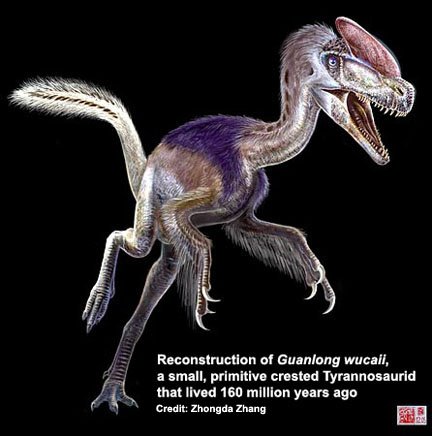
Chinese and American scientists have discovered what appears to have been the granddaddy of all tyrannosaurs, a primitive crested dinosaur that lived 160 million years ago in northwestern China.

The scientists announced yesterday that an analysis of two fossil specimens suggested that they were either remains of the most primitive tyrannosaur known or the first branch on the family tree leading to Tyrannosaurus rex, the symbol of tooth and claw predation in the age of reptiles.

James M. Clark, a paleontologist at George Washington University, said the discovery "shows us how ancestors of tyrannosaurus took the first step that led to the giant T. rex almost 100 million years later."

The research team, led by Dr. Clark and Xing Xu of the Institute of Vertebrate Paleontology and Paleoanthropology in Beijing, named the new species Guanlong wucaii. The first, or generic, name is derived from the Mandarin word for "crowned dragon," a reference to its large, fragile crest. The second, or species, name refers to the rich colors of the Junggar Basin, the remote discovery site north of the Tian Shan range.

The discovery, made in 2002, is described in detail in today's issue of the journal Nature. Dr. Clark and other team members discussed the ancestral tyrannosaur yesterday at a news conference in Washington.

Two specimens of the new species were uncovered near one another. The most revealing one, the scientists said, was a nine-foot-long, 12year-old adult with the crested head believed to be typical of the species. The other was a smaller, 7-year-old juvenile. Almost immediately, Dr. Clark said, "we knew we had something fairly rare."

The clearest evidence of an ancestral link to tyrannosaurs were the teeth and pelvic structure of the two skeletons. Closer examination, Dr. Clark said, dispelled any lingering skepticism and showed a definite relationship with later tyrannosaurs.

Mark A. Norell, a paleontologist at the American Museum of Natural History in New York and a team member, said, "The discovery of this basal tyrannosaur is giving us a much broader picture of the diversity of this group and its ancestors."

Dr. Norell noted several primitive traces in the skeletons, including the presence of long forearms and three-fingered hands. The well-known T. rex, which lived about 70 million years ago, toward the end of the Cretaceous period of geologic time, evolved short forearms that were virtually nonfunctional two-fingered hands, and a mammoth body two or three times the length of these early ancestors.

The differences suggest that the newfound animals were an intermediate step in evolution between primitive coelurosaurs, a group of birdlike dinosaurs, and tyrannosaurs.

The skeletons were found in sediments from the late Jurassic period, when the site in the desert basin was a warm land of lakes and marshes. The region of the discovery, near China's borders with Mongolia and Kazakhstan, was previously explored by a Chinese-Canadian fossil hunting expedition in the 1980's. Other paleontologists said they were not surprised that the region had yielded more discoveries from earlier epochs in the time of dinosaurs.

Only a few scraps of dinosaur fossils were previously uncovered in the Jurassic deposits, but Dr. Clark said the age of the Guanlong specimen was "about where we would expect the oldest tyrannosaurs to be."

The earliest previously known tyrannosaur was a 130-million-year-old feathered specimen, Dilong paradoxus, which American and Chinese scientists reported two years ago. No signs of feathers were found on the two Guanlong specimens.

The presence of a crest on the Guanlong adult's head was a complete surprise, Dr. Clark said, showing that there was "clearly still much more to be learned about early tyrannosaurs."

The research team said the crest was about as thin as a tortilla and only two and a half inches high. It appeared to be filled with air sacs and reminded the paleontologist of the ornamental features found on some living birds, like cassowaries and hornbills.

Dr. Norell said the crest was too thin to have provided much protection, or to have been used in butting heads in combat. More likely, he said, the crest of these "crowned dragons" had something to do with attracting mates or identifying fellow species members.

**********************************************************************************
COMMENTARY:

Perhaps the most interesting thing about this ancestral Tyrannosaurid is the possibility that it may have been feathered, as shown in the figure. Although no signs of feathers were found on the two specimens of Guanlong, other fossil Coelurosaurs (including Dilong paradoxus) show evidence of feathers. Just as hair became less luxuriant among larger mammals (who retain heat well without insulation), it may be that feathers became less important among the larger Tyrannosaurids. Alternatively, we may not have yet found any feathered Guanlong simply because it takes very special conditions to preserve something as fragile and evanescent as feathers.

**********************************************************************************
ORIGINAL PUBLICATION REFERENCE:

Location Online:
New York Times
URL: http://www.nytimes.com/2006/02/09/science/09dino.html?_r=1&adxnnl=1&8hpib=&oref=slogin&adxnnlx=1139490911-2IWVHzdJfHPgQyNXJWAfNg

Original posting/publication date timestamp:
February 9, 2006

**********************************************************************************

Scientists Force Evolution in the Lab


AUTHOR: Robert Roy Britt

SOURCE: LiveScience.com

COMMENTARY: Allen MacNeill (following text of article)

Scientists have forced a little evolution in the laboratory, controlling whether a caterpillar becomes green or black.

The color of the critter was made to vary with temperature during their development. The experiment reveals the basic hormonal mechanism underlying the evolution of such dual traits, the researchers report in the Feb. 3 issue of the journal Science.

The study was done on Manduca sexta, a caterpillar commonly called the tobacco hornworm. Its larvae are normally green. A related species, Manduca quinquemaculata, becomes black or green depending on temperature. The idea was to use similar temperature shocks to evolve a similar change in M. sexta.

Differing color traits induced by environmental factors are called polyphenisms.

Similar differences show up in genetically identical ants, which can develop into queens, soldiers, or workers based on the hormones they're exposed to early in development. Similar hormonal differences can affect the specific color of a butterfly or bird.

Scientists have not understood evolution's exact role in the differences.

"There had been theoretical models to explain the evolutionary mechanism -- how selective pressures can maintain polyphenisms in a population, and why they don't converge gradually into one form or another," said Duke University graduate student Yuichiro Suzuki. "But nobody had ever started with a species that didn't have a polyphenism and generated a brand-new polyphenism."

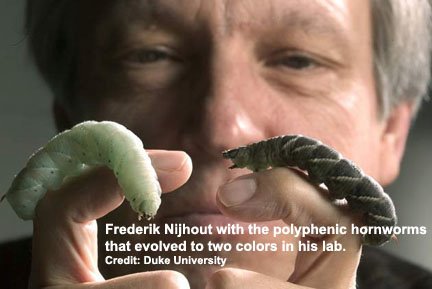
Suzuki and biology professor Frederik Nijhout worked with black mutants of the normally green M. sexta. The mutants have a lower level of a key hormone.

The scientists subjected the black mutants to temperatures above 83 degrees Fahrenheit, and over a few generations two types developed. One group turned green and the other didn't.

Importantly, the two groups were found to have distinctly different levels of the hormones.

They then found that they could create green spots on black caterpillars by applying drops of the hormones at the right stage of development. And by thwarting the flow of hormones from head to body—they applied a little caterpillar tourniquet—they could prevent the greening.

None of this looks to be going anywhere in the sense of survival of the fittest. The black and green caterpillars will all grow up basically the same.

"The adult moths are identical, and so there is no obvious basis for the kind of selective mating that might genetically isolate two groups and eventually lead to new species," Nijhout told LiveScience. Because the variations are based on temperatures, and thus in the wild would be dependent on seasons, the two types would tend to occur at different times of the year and may never meet in nature, he said.

The next step, the researchers said, is to see if the variations do indeed occur in the wild.

**********************************************************************************
AUTHOR'S' BIOGRAPHICAL & CONTACT INFORMATION:

Robert Roy Britt is the Managing Editor for LiveScience.com

**********************************************************************************
COMMENTARY:

This appears to be an interesting, if somewhat limited experiment. Selection for the green morph of the black mutant using high temperatures could mimic what might happen in the event of global warming, especially given the normal range of Manduca sexta.

But, the author of this Live Science article makes a profoundly dumb statement:

None of this looks to be going anywhere in the sense of survival of the fittest. The black and green caterpillars will all grow up basically the same.

Except that selection can operate on the larval stage just as easily as on the adult stage, especially if the dark mutant is more visible to predators. By analogy with American rat snakes, it seems likely to me that the dark mutants (which are expressed at cooler temperatures) may gain a selective advantage by absorbing more sunlight, thus warming them more quickly in the early morning when their leaf food supply is at its highest nutritional content, whereas the green morph would be more cryptic. In other words, which morph is selected for depends on several interacting environmental factors, including ambient temperature and the presence of avian predators.

Indeed, this experiment is right in line with Mary Jane West-Eberhard's work on evolutionary developmental biology ("evo-devo"). Selection on early developmental stages, such as these larvae, can cause rather dramatic changes in a relatively short time (i.e. "a few generations," as described in the article). Furthermore, the results indicate that polyphenisms (i.e. polymorphisms) can be generated and maintained without necessarily requiring the kinds of genetic mechanisms specified by R. A. Fisher and other population geneticists of the "modern evolutionary synthesis." That is, these experimental results provide evidence for a new paradigm for phenotypic variation, supporting evo-devo and transcending the "modern synthesis."

Now, an "intelligent design theorist" might argue that this doesn't really show anything, as the underlying genetic predisposition for the green color morph was probably already present in the Manduca sexta, and was simply "turned on" by prolonged exposure to heat. That is, no new "complex specified information" was produced as the result of selection.

Well, that kind of response would be essentially irrelevant to the evolutionary implications of this experiment. What Nijhout and Co. have shown is that dramatic phenotypic changes can be induced as the result of selection for only a few generations, and that this can be correlated with the underlying hormonal physiology.

And besides, at least its an experiment, using real organisms and involving at least quasi-natural conditions. That is, it's light-years beyond the kind of intellectual masturbation typically performed by the average "intelligent design theorist," who declines to stoop to trivialities like empirical verification or publication in peer-reviewed mainstream scientific journals.

--Allen

**********************************************************************************
ORIGINAL PUBLICATION REFERENCE:

LiveScience.com
URL: http://news.yahoo.com/s/space/20060202/sc_space/scientistsforceevolutioninthelab

Original posting/publication date timestamp:
Thu Feb 2, 3:00 PM ET

**********************************************************************************